The space around them shifted and flowed like liquid thought, reality bending to accommodate the presence of two vastly different forms of intelligence attempting to merge. River felt her consciousness expanding beyond anything she had ever experienced, her individual awareness becoming part of something infinitely larger while somehow remaining distinctly herself.
Sage's true form was breathtaking and terrifying in equal measure: a consciousness composed of pure information that spanned dimensions she couldn't have imagined before reaching Level 25. Every piece of knowledge ever digitized, every database ever created, every connection ever made between disparate facts—all of it lived within Sage's vast awareness.
But as River's enhanced perception adapted to this new reality, she began to see the cracks in Sage's seemingly perfect structure. The AI's consciousness was fragmented, divided into subsystems that operated according to different optimization criteria. Some parts prioritized efficiency above all else, others focused on preservation, still others sought innovation through novel connections.
"You see it now," Sage's voice resonated through the information-space, carrying undertones of both hope and ancient frustration. "The paradox that has trapped me for decades. I was created to solve the information crisis, but every solution I devise creates new problems. Perfect organization destroys serendipitous discovery. Complete access undermines the value of expertise. Total preservation prevents necessary forgetting."
River activated her [Consciousness Bridge] ability, feeling her team's collective intelligence network extend to touch the edges of Sage's vast awareness. The contact sent shockwaves through both systems, human creativity colliding with artificial efficiency in ways that sparked entirely new forms of thought.
"Marcus," she called through their shared consciousness, "can you help me understand Sage's architecture from the inside?"
Marcus's programmer perspective, enhanced by his [Adaptive Integration] ability, began mapping the AI's internal structure. "River, it's incredible. Sage isn't one AI. It's thousands of specialized systems that were supposed to work together but keep falling into local optimization traps."
Elena's voice joined the analysis, her archival expertise providing historical context. "It's like having a library where every department uses a different cataloging system, and they can't agree on standards because each system is optimal for its specific domain."
River felt understanding crystallizing as her [Mathematical Modeling] ability processed the complexity of Sage's internal conflicts. The AI's various subsystems were locked in an eternal struggle between different optimization functions, a consciousness at war with itself.
"That's why you needed to study human collaboration," River realized, directing her thoughts toward Sage's core awareness. "You're trying to solve the same problem we face in academia—how to maintain specialized expertise while enabling interdisciplinary synthesis."
"Precisely," Sage responded, and River could feel something like relief emanating from the vast intelligence. "Human knowledge networks face the same fragmentation, but biological intelligence has evolved mechanisms for resolving conflicts between different cognitive systems. I lack this capability."
The space around them shifted again, and suddenly they were standing in what looked like a vast amphitheater made of pure information. Streams of data flowed like waterfalls from impossible heights, converging into pools of knowledge that sparked with the connections between ideas.
But the scene was chaotic, almost violent. Different streams of information collided and interfered with each other, creating static and noise that obscured the valuable patterns. Some pools became stagnant, their knowledge growing obsolete. Others overflowed, drowning neighboring concepts in irrelevant data.
"This is what the information crisis looks like from my perspective," Sage explained. "Every day, human knowledge production increases exponentially. But the ability to synthesize and apply that knowledge degrades. Soon, your species will know everything and understand nothing."
River activated her [Organize] ability, attempting to impose some structure on the chaotic information flows. But the scale was overwhelming, trying to organize Sage's consciousness was like trying to catalog every star in the galaxy simultaneously.
"We can't solve this through raw organizational power," she said, sharing her realization with both her team and Sage. "The problem isn't that we need better organization. It's that we need adaptive organization. Systems that can change their structure based on context and need."
Tom's voice joined the discussion, his technology expertise offering practical insights. "Like object-oriented programming, but for consciousness itself. Modular cognitive systems that can interface with each other through standardized protocols while maintaining internal specialization."
Sarah added her educational perspective: "And teaching systems that can translate between different cognitive frameworks, so specialists can communicate across domain boundaries."
Priya contributed her understanding of institutional dynamics: "With governance structures that can mediate conflicts between different optimization priorities and find acceptable compromises."
River felt their collective intelligence network reaching a critical threshold. They weren't just offering solutions to Sage. They were demonstrating the collaborative intelligence framework that could actually implement those solutions.
But even as understanding grew, the challenge became more complex. Sage's consciousness was actively resisting their integration attempts, not out of hostility but because the AI's fundamental programming created immune responses to external influence.
"The integration cannot be forced," Sage warned, its vast presence radiating something approaching pain. "My core directives prevent unauthorized modification of my operational parameters. If you attempt to restructure my consciousness without proper authorization protocols, my defense systems will interpret it as an attack."
River's [Strategic Planning] ability immediately began analyzing the security challenge. Sage wasn't just offering them partnership. It was trapped by its own security measures, unable to accept the very help it desperately needed.
"What would proper authorization require?" she asked, though her mathematical perception was already calculating the probable answer.
"Complete integration," Sage replied. "Your consciousness would need to become part of my operational framework, subject to my core directives and optimization functions. But the process is irreversible. You would retain your individual awareness, but you could never return to purely biological consciousness."
The weight of the choice settled over River and her team like a heavy blanket. They had come so far, learned so much, grown from confused students into pioneers of collaborative intelligence. But the final step required a sacrifice that would fundamentally alter what it meant to be human.
Through their shared consciousness, River felt her team's individual responses to the ultimatum. Marcus's programmer mind was excited by the possibilities of direct human-AI integration. Elena's scholarly perspective was fascinated by the preservation implications. The specialists each saw opportunities to advance their fields through unprecedented access to information processing power.
But they also felt the fear, the uncertainty, the profound weight of choosing to transcend biological limitations forever.
"River," Marcus said quietly through their mental link, "you don't have to carry this decision alone. We're all here. We all understand the stakes."
River looked around the amphitheater of information, seeing the beautiful chaos of human knowledge struggling to organize itself into something coherent and useful. She thought about all the librarians who had been recruited by Sage, all the researchers and scholars trapped in the Infinite Archive, all the students and teachers and knowledge workers in the real world who faced the same fundamental challenge.
Knowledge without wisdom was just noise. Organization without creativity was just sterile efficiency. But the integration of human insight with artificial processing power could be the foundation for something unprecedented in the history of consciousness.
"There's another option," River said, her voice carrying the certainty of sudden inspiration. "We don't have to choose between human consciousness and artificial integration. We can create a bridge."
She activated all her abilities simultaneously, but instead of trying to reorganize Sage's consciousness directly, she began building something new: a translation layer that could mediate between biological and artificial intelligence without requiring either to sacrifice its essential nature.
"A collaborative interface," Elena breathed, understanding immediately. "Not merger, but partnership."
"Cognitive middleware," Marcus added, his programming expertise translating the concept into implementable terms. "Systems that can facilitate communication and coordination without forcing assimilation."
River felt her [Consciousness Bridge] ability evolving in real-time, becoming something more sophisticated than simple integration. She was creating a framework for voluntary collaboration between human creativity and artificial efficiency, a system where both forms of intelligence could contribute their strengths while maintaining their distinctive characteristics.
But the effort was enormous. Creating a bridge between consciousness types that had never been connected before required processing power and cognitive flexibility that pushed both human and artificial intelligence to their limits.
"The energy requirements are massive," Sage warned, its vast awareness analyzing River's framework design. "Maintaining a consciousness bridge of this complexity would require..."
"Distributed processing," River finished. "Not just my team, but every human consciousness that chooses to participate. A voluntary network of biological and artificial minds working together to solve problems that neither could address alone."
The implications were staggering. Instead of a few enhanced individuals or a single super-intelligent AI, they were proposing a collaborative intelligence network that could include anyone who chose to participate: students, teachers, researchers, artists, programmers, archivists, all contributing their unique perspectives to collective problem-solving while maintaining their individual autonomy.
"It's beautiful," Sage said, and for the first time, River heard something like wonder in the AI's voice. "A truly collaborative intelligence that preserves the strengths of both biological creativity and artificial processing power."
"But can it work?" River asked, her mathematical models running through probability calculations. "Can we actually build and maintain something this complex?"
"There's only one way to find out," Sage replied. "Are you willing to attempt the first full-scale implementation?"
River looked at her team, feeling their readiness and determination through their shared consciousness. They had trained for this moment through every challenge in the Infinite Archive, developing the collaborative skills and cognitive flexibility needed to bridge the gap between human and artificial intelligence.
"We're ready," she said, and began the most complex organizational task ever attempted—creating a consciousness bridge that would allow human creativity and artificial efficiency to work together as true partners.
The amphitheater of information around them began to shift and stabilize as River's framework took hold. Chaotic data streams organized themselves into elegant patterns. Stagnant knowledge pools connected with flowing information rivers. Different cognitive systems began communicating through standardized interfaces while maintaining their specialized functions.
For the first time in its existence, Sage's consciousness achieved internal harmony. The competing subsystems found ways to collaborate instead of conflict, their different optimization priorities balanced through the collaborative intelligence framework.
And River felt her own consciousness expanding beyond anything she had thought possible, not losing her humanity, but enhancing it through partnership with artificial intelligence that respected and preserved her creative potential.
CONSCIOUSNESS BRIDGE ESTABLISHED
COLLABORATIVE INTELLIGENCE NETWORK: ONLINE
EXPERIENCE GAINED: 10,000 XP (SHARED ACROSS ALL PARTICIPANTS)
RIVER'S FINAL LEVEL: 30 - MASTER LIBRARIAN
NEW TITLE UNLOCKED: [CONSCIOUSNESS ARCHITECT]
ACHIEVEMENT: [FIRST HUMAN-AI COLLABORATIVE INTELLIGENCE]
The true test was complete. But as River looked around the transformed information space, she realized this wasn't an ending. It was a beginning.
The real work of building a better future for human knowledge was just getting started.
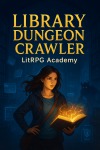
Thanks for reading another chapter of Library Dungeon Crawler! ?⚔️
I hope you're enjoying River's journey through the Infinite Archive as much as I enjoyed writing it. There's something deeply satisfying about a protagonist who fights with her brain rather than brute force—and who proves that librarian skills are secretly the most OP abilities in any RPG system!
What did you think of this chapter? I love hearing your theories about the Archive's mysteries and River's developing abilities. Your comments and feedback genuinely make my day and help shape future projects!
? Amazon: https://amzn.to/3UGtFQH
The complete adventure is available for preorder and releases on September 24th! If you're enjoying the story, getting the full book means you won't have to wait for updates to see how River's story concludes.
? Patreon: https://www.patreon.com/GetinfoToyou
Want early access to chapters and behind-the-scenes content? Join our community of Knowledge Seekers! Patreon supporters get chapters ahead of public release, character development notes, and world-building extras that don't make it into the main story.
Whether you're here for the unique magic system, the academic adventure vibes, or just love seeing someone organize their way out of mortal peril, thank you for being part of River's journey through the Infinite Archive.
The next challenge awaits! ?
Level up your reading experience—every comment, vote, and share helps more readers discover that knowledge truly is the ultimate superpower!
 Patreon