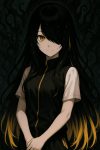
Eclipsara pov(first person point of view)
We ran up the stairs two at a time.
Halfway up, I heard it.
A sound from below.
Not loud.
Not rushing.
Just… slow movement.
Wood creaking.(A slow, strained noise from wood. Context: The stairs are reacting to weight moving on them.)
Something brushing against the walls.(Something is sliding or dragging along the surface. Context: Whatever is coming upstairs is big or close to the walls.)
They were inside.
“They’re coming up.” I whispered.
“I hear it.” Mira breathed.
We didn’t slow down.
At the top of the stairwell, we burst through the rooftop door. Cold night air slammed into us.(The cold hit suddenly and hard. Context: Going from indoors to outside shocked their bodies.)
“Block it!” Mira said.
There was an old metal chair near the rooftop’s edge(The outer boundary of the roof. Context: One wrong step would mean falling.)-rusted(Covered in corrosion from age and moisture. Context: The chair is old and neglected.), bent, but heavy enough.
I grabbed it and dragged it across the gravel(Small, loose stones. Context: The rooftop surface isn’t smooth; it crunches underfoot.). The scraping sound (A loud dragging noise. Context: The chair moving across gravel makes it dangerously noticeable)felt way too loud. Together, we jammed(Forced into place so it can’t move. Context: They block the door to stop it from opening) it under the rooftop door handle, wedging (Forced into place so it can’t move. Context: They block the door to stop it from opening)it tight against the frame.
Below us-
A dull thud.
The stairwell door rattled once.(Something tested the door. Context: The creatures checked if it would open.)
Then silence.
We didn’t wait to see if it would hold.
We ran.
The night air hit my face like ice as we sprinted across the first rooftop.
Ahead-another building.
There was a gap.
Not wide.
But wide enough to matter.
“Can you make that?” Mira asked quickly.
“Yes,” I said without slowing.
We jumped.
For a split second, there was nothing under my feet-just air and the hollow drop between buildings.
Then we landed hard on the other side.
“Go!” Mira urged.
We kept running.
Another gap. Another jump.
Again.
Again.
Again.
By the fourth building my legs were already burning. By the eighth, my lungs felt raw. By the twelfth-
We finally stopped.
Neither of us had looked back.
Neither of us wanted to.
“This is far enough,” Mira panted, scanning the surrounding rooftops. “Twelve buildings… they’d have to see us to follow.”
I forced myself to turn slightly, scanning the rooftops behind us.
Nothing moved.
No pale limbs dragging themselves over ledges.
No towering silhouettes against the sky.
Still, I didn’t trust it.
“There,” I said, spotting a small rooftop access structure. A metal door leading down. “We go inside.”
We crossed the roof and slipped through the door, closing it quietly behind us.
This building felt abandoned.
Broken windows.
Dust hanging thick in the air.
Walls cracked, paint peeling in long strips.
We moved deeper inside instead of staying near the entrance, taking turns through narrow hallways and side paths until we found a room that would take time to reach from any direction.
Only then did we approach a shattered window and carefully peek out.
The street below was silent.
No towering silhouettes.
No pale figures pressed against glass.
Nothing.
“They’re not here,” Mira whispered.
I checked again, scanning rooftops, alleys, shadows.
Nothing moved.
I finally let out a breath I hadn’t realized I’d been holding.
We slid down against the wall beneath the window, sitting on the dusty floor.
For a moment, neither of us spoke.
Then I asked quietly, “How did they find us?”
Mira stared at the opposite wall, her jaw tight.
“I don’t know,” she admitted. “But they weren’t wandering.”
“You think they were following us?” I asked. “Since earlier?”
Her expression darkened. “What if one of them saw us when we were out in the open? When we were walking through the streets?”
A cold realization settled in my stomach.(A bad truth sank in.)
“…Spying on us.” I muttered. “Tracking us the whole time.”
Mira didn’t answer.
That was answer enough.
After a moment, she exhaled slowly. “We can’t stay exposed like that again.”
I nodded. “Building to building is safer.”
“Way safer,” she agreed. “Some of them are too big to move easily indoors. And buildings give us choke points(Narrow areas that limit movement. Context: Doors and stairwells make it easier to defend or escape.)-doors, stairwells, tight corridors.”
“Multiple exits,” I added. “Multiple paths if we need to split or circle back.”
“Exactly.”
Silence settled((Fully took hold. Context: The fear didn’t pass-it stayed.)) again before Mira spoke, quieter this time.
“I killed a few of them before I found you at the manor.”
I turned to her. “You did?”
She gave a faint, almost disbelieving huff. “Yeah. I surprised myself. First time ever using a sniper rifle.”
I blinked at her. “So you’re telling me you picked up a weapon you’ve never used before and just started killing those things like a boss?”
For a second, despite everything, she actually smiled.
“Apparently,” she said. “Desperation unlocks hidden talents.”
She leaned her head back against the wall.
“I’m still new at it.” she admitted. “But I can use the scope to see from far away. Scout areas before we move. If something’s waiting for us, I’ll know.”
“That helps,” I said quietly. “A lot.”
“Also, I forgot to mention this…” Mira took a deep breath. “But magic is completely blocked off for me in this place. And before you ask, I don’t know why.”
Another silence fell.
“…We’re not going back to the newspaper,” I added.
Mira shook her head immediately. “No. Absolutely not. For all we know, one of them is already inside.”
“Or waiting.”
“Yeah.”
I hesitated.
“Then where do we go?”
She didn’t answer right away.
Her usual certainty wasn’t there.
“…I don’t know,” she admitted softly.
That scared me more than the creatures did.
“But right now,” she continued, straightening slightly, “we rest. Even if it’s just for a little while.”
“You think they’re searching for us?”
“I think they don’t give up easily,” she said. “And if they were tracking us before… they might still be.”
The building creaked faintly around us.
Dust shifted somewhere deeper inside.
“We’ll move once we’ve caught our breath.” Mira said quietly. “But for now… we stay quiet.”
I nodded.
Then I closed my eyes.
I don’t know how long I slept.
It couldn’t have been more than an hour.
When I opened my eyes, the room was still dim(Not very bright.), dust floating lazily(Dust drifting slowly in the air. Context: Nothing has disturbed the room in a long time.) in the weak light from the cracked window. For a split second, I forgot where we were.
Then it all came rushing back.
The window.
The creatures.
The eyes.
I sat up quickly.
Mira was already awake, sitting against the wall across from me, staring at nothing in particular.
“You sleep at all?” I asked quietly.
“A little.” she said. “You?”
“Enough.”
I hesitated before asking, “Do you… have any idea what we should do next?”
She exhaled through her nose.
“Not yet.” she admitted. “But sitting here forever isn’t an option.”
I nodded.
“Maybe we check the building.” she continued. “See if there’s anything useful. Supplies. Information. Anything.”
“Better than waiting.” I said, pushing myself up.
We searched the building methodically.(Dust drifting slowly in the air. Context: Nothing has disturbed the room in a long time.)
Room by room.
Hallway by hallway.
Most of it was empty-rotted furniture, broken glass, collapsed ceilings. Whatever this place used to be, it had been abandoned long ago.
After nearly an hour, frustration started creeping in.
“This is pointless.” I muttered. “There’s nothing here.”
“Give it another few minutes.” Mira replied, though even she sounded doubtful.
She moved into what looked like an old lounge area(A common sitting or waiting area. Context: A place meant for relaxing or gathering.), most of the furniture overturned or torn apart.
Then she stopped.
“…Wait.”
I looked over.
She was crouched near a collapsed couch, reaching underneath it.
When she pulled her hand back out, she was holding a folded newspaper.
Her brows furrowed immediately.(Her eyebrows pulled together. Context: She’s confused or concerned.)
“What is it?” I asked.
“I… don’t know.” she said slowly.
She unfolded it.
Then she froze.
I walked over and looked at the front page.
The bold headline read:
FORMER ORPHANAGE HAS BECOME NEW RESEARCH FACILITY - ORDERED DIRECTLY BY THE DEMON KING
Beneath it was a short explanation stating the facility would not be open to the public under any circumstances.
My stomach tightened.
“The Demon King…” I murmured.
Mira didn’t respond right away.
We both already knew which one it had to be.
The old Demon King.
Her grandfather.
The one in the photograph.
“It has to be him,” I said quietly. “The one from the picture.”
Mira’s expression had shifted-not fear, not confusion exactly. Something deeper.
“…I guess so,” she said softly.
The article listed a location.
An exact address.
I glanced back at her.
“You’re surprised because this never happened in the real Daemina, right?” I said. “An orphanage turning into a research facility?”
She nodded slowly.
“There was an orphanage there,” she said. “I remember it. It never became a research facility. Not in our world.”
“And especially not one ordered by your grandfather,” I added.
Her jaw tightened slightly.
“What kind of person was he?” she murmured more to herself than to me. “Why did my father never talk about him? Just… surface-level things.”
"You told me you never really asked about him much."
“True, but when I asked dad about him, dad only said it was boring stuff.” She looked down at the newspaper again. “That it was complicated.”
Silence lingered between us.
A research facility.
Ordered directly by the Demon King.
Not open to the public.
In a version of Daemina where history didn’t match our own.
Mira finally looked up at me.
“Do you think we should go there?”
I didn’t hesitate.
“If there’s anywhere that might have answers, it’s a research facility,” I said. “Especially one that wasn’t supposed to exist.”
She nodded slowly.
“I know where that location is,” she said. “Or at least… where it should be.”
“Then we go,” I replied.
“But building to building,” she added quickly. “No open streets.”
“Agreed.”
“It’ll take a while,” she warned. “If we avoid detection.”
“That’s fine,” I said. “Slow is better than dead.”
For the first time since I woke up, Mira’s expression steadied.
“Alright,” she said, folding the newspaper carefully and tucking it into her pocket. “Let’s move.”
And this time-
We would stay out of sight.
Moving building to building sounded easier when we said it out loud.
In reality?
It was exhausting.
We slipped through hallways, climbed broken stairwells(The area that contains stairs inside a building. Context: They’re climbing between floors using stairs), squeezed through collapsed doorframes, and crossed narrow rooftops where the wind threatened to shove us off balance.(Not wide. Context: The rooftops leave very little room to walk safely.)
And the dust.
Gods, the dust.
Every step kicked up a cloud of it.
I coughed for what felt like the fiftieth time as we ducked under a fallen beam.(A long, sturdy piece of wood or metal that supports a building. Context: A fallen beam blocks their path, forcing them to duck.)
“Does every abandoned building in this version of Daemina have to be filled with ancient, cursed dust?” I muttered.
“Because no one’s been here in years?” Mira whispered back.
“Rhetorical question.”(A question not meant to be answered. Context: The speaker is complaining, not actually asking.)
Mira, ahead of me, snorted quietly. “You’re the one who decided we shouldn’t walk in the open.”
“I stand by that decision.” I said, shifting(Adjusting or changing position. Context: she moves her grip to hold the axe better.) my grip on the axe. “I just didn’t account for inhaling half the city.”
We had to jump another gap.
Not wide.
But I still hated it.
I stepped back, adjusted my balance, and jumped.
Landing was harder with only one good hand.
My left arm-what remained of it-still threw off my center of gravity. Holding the axe in my right hand didn’t help. Every time I landed, I had to compensate awkwardly to avoid tipping sideways.(Losing balance and leaning to one side. Context: His missing hand makes landing unstable.)
We climbed over a collapsed desk inside the next building. I awkwardly balanced the axe in my right hand while trying to steady myself with what was left of my left arm.
I hated how unbalanced I felt.
Every time I had to vault something (To jump or climb over an obstacle using momentum. Context: She has trouble clearing objects with one arm.)or catch myself, the absence of my hand screamed at me.
I pushed myself over a broken cabinet-
-and immediately slipped.
I fell forward and face-planted straight into an old couch cushion someone had left overturned.(Fell forward and landed face-first.)
Dust exploded everywhere.
For a second, neither of us moved.
Then Mira choked back a laugh.
“…You okay?” she asked carefully.
My voice was muffled in fabric. “I meant to do that.”
“You dove.”
“I was testing the structural integrity(How strong and stable something is.) of the couch.”
She lost it for a second, laughing quietly before covering her mouth. “You almost rolled off the roof earlier too.”
“I said I’m fine.”
“You absolutely were not fine.”
We dropped down through another rooftop access point and navigated around a collapsed staircase. At one point, I had to climb over a pile of broken cabinets using one arm and my knees, hooking the axe into a crack just to pull myself up.
“I swear this city is personally offended by our existence,” I muttered as I awkwardly hauled myself over.
Mira glanced back at me. “You should’ve seen it before.”
I looked at her. “What were these buildings, anyway?”
She slowed slightly as we passed through what looked like an old office floor.
“This area used to be mixed-use,” she explained. “Residential(Meant for people to live in. Context: Apartments or homes were on upper floors.) on top, shops or small businesses on the lower levels. That one”-she pointed to a cracked wall with faded paint-“used to be a textile shop(Fabric or cloth.). Family-owned. They’d hang fabrics out the windows during festivals.”
I tried to picture it.
Bright cloth instead of shattered glass.
Voices instead of silence.
“And this one?” I asked as we stepped carefully down a narrow staircase, pushing through scattered cushions and broken furniture at the bottom.
“Administrative building.(A building used for paperwork and offices.)” she said. “Permits. Trade documents. Boring stuff.”
“And that one?” I asked, nodding toward a distant rooftop with a broken tower structure.
“Clock repair shop.” she said immediately. “Owner was grumpy. Hated kids.”
I blinked at her. “You’ve broken into a lot of places as a child, haven’t you?”
“Explored,” she corrected.
“Right. Explored.”
We kept moving.
More narrow corridors.
More jumping.
More dust.
And then-
“Oh, come on,” I groaned.
Another gap between buildings.
Not huge.
Just irritating.
I adjusted my grip on the axe.
“You know,” I muttered, “whoever designed cities with these dramatic rooftop gaps deserves consequences.”
Mira smirked. “You jumped twelve of them earlier.”
“Adrenaline,” I replied. “And fear. Both are excellent motivators.”
We jumped again.
And again.
Sometimes we couldn’t jump, so we had to climb down a level, cross through an interior hallway, then climb back up another staircase to reach the next rooftop.
It was slow.
Careful.
Annoyingly careful.
At one point, I had to wedge my axe between two pieces of masonry(Brick or stone used in buildings.) just to steady myself while stepping over a collapsed railing.
“This is ridiculous,” I muttered. “I am fighting horrors with one hand while doing rooftop gymnastics.”
Mira looked over her shoulder. “You’re doing pretty impressive rooftop gymnastics.”
“That was not impressive.”
“You face-planted into a couch and kept going. That’s resilience.”
I huffed. “That’s humiliation.”
After what felt like an hour-maybe two-we finally slowed.
“Let’s get a better look.” Mira said, spotting a taller building ahead.
We climbed one last stairwell, legs aching, lungs burning, and stepped onto the rooftop.
The wind was stronger up here.
The city stretched out in broken lines and jagged silhouettes.
Mira walked to the edge carefully and scanned the horizon.
I stayed a few steps back, keeping watch behind us.
She turned slowly, orienting herself.(Figuring out where she is. Context: She uses landmarks to navigate.)
“…Okay,” she murmured. “I recognize that tower.”
“Good or bad?” I asked.
“Good. It means I know where we are.”
I moved closer. “And?”
She pointed toward a distant section of the city.
“The orphanage-well, where it should be-is that direction.”
I followed her gaze.
It wasn’t too far.
But it wasn’t close either.
She hesitated slightly.
“…There’s a problem.”
“What?”
“We can’t do rooftops the whole way,” she said. “There’s a wide street cutting across that section. Too open. No adjacent buildings close enough to jump.”
I already knew what she was about to say.
“We’ll have to go on the streets for a bit.”
A small knot formed in my stomach.
“How long?”
“Not too long,” she said. “But long enough that we’ll need to move carefully.”
I tightened my grip on the axe.
“Alright,” I said quietly. “Then we make it quick.”
Mira gave a small nod.
“Quick,” she agreed.
We climbed down from the rooftop in silence.
The moment my boots touched the street, everything felt wrong.
Too open.
Too exposed.
Mira pressed herself against the nearest wall, slipping into the shadow cast by a broken balcony(a small platform that sticks out from a building, usually with a railing. Here, the broken balcony creates shadow to hide in.) above.
I followed immediately.
We moved slowly.
Carefully.
Every step deliberate.(done with purpose and care. They are thinking about every movement to avoid danger.)
We stayed close to buildings, weaving(means moving back and forth in a careful, zigzag way. They aren’t walking straight — they’re dodging obstacles and staying hidden.) between collapsed carts, shattered pillars(means moving back and forth in a careful, zigzag way. They aren’t walking straight — they’re dodging obstacles and staying hidden.), and deep pockets of shadow(areas where shadows are thick and dark. Good places to hide because light doesn’t reach them well.). Whenever the wind shifted or debris scraped faintly across stone, we froze.
Completely still.
Listening.
My heart pounded in my ears.
I scanned rooftops.
Windows.
Alleyways.
Every dark corner felt like it could suddenly grow eyes.
Twenty-five minutes passed like that.
Silent.
Tense.
Until Mira slowed.
“There.” she whispered.
I followed her gaze.
At the end of the street stood a larger structure, wider than the surrounding buildings. Its front sign had partially collapsed, but faint lettering still clung to the stone.
The former orphanage.
Now supposedly a research facility.
Or what was left of it.
It looked broken like everything else-windows shattered, sections of the roof collapsed inward( Collapsed inward means parts of the roof fell down into the building, not outward onto the street.). The front door hung slightly open, swaying faintly in the wind.
I swallowed.
“You think we’ll actually find something in there?” I asked quietly.
Mira kept staring at it.
“I hope so.” she said. Then, after a pause, “I hope even more that there aren’t any of those things inside.”
“Same.” I muttered. “Very much same.”
We stayed in the shadows a moment longer, watching the entrance.
Nothing moved.
But that didn’t mean anything.
Mira’s expression shifted, growing distant.(lost in thought or memory)
“…Why would he do that?” she murmured under her breath.
“What?” I asked.
“My grandfather.” she said quietly. “Why would he turn an orphanage into a research facility?”
There was frustration in her voice now.
“And why did my father always brush him off whenever I asked?” she continued, more to herself than to me. “Every time I asked, it was complicated or boring or not important.”
She shook her head slightly.
“I never pushed it. I wasn’t interested. I didn’t care. Those answers were enough for me. I was satisfied with my life because what mattered were the people already in it.”
Her jaw tightened.
“Now I wish I had.”
I hesitated before speaking.
“Maybe the grandfather in this world isn’t the same as the one in ours.” I said gently. “Maybe something changed here. Maybe his personality was completely different. Maybe he made different choices.”
I glanced at her.
“Like Vemmora.”
Mira’s eyes shifted toward me.
“We met a version of Vemmora that was nothing like your mother.” I continued quietly. “And Sylvarius said they were different people. The Vemmora inhabiting your mother… she described her as vengeful. Insane.”
Mira’s expression darkened slightly at the memory.
“So maybe it’s the same thing here,” I said. “Maybe this version of your grandfather isn’t the one you would’ve known if he was alive back in our world.”
She stared at the building again.
“…Maybe.” she said softly.
“But that still doesn’t explain why my dad avoided talking about him.” she added softly. “If he was just boring, that wouldn’t be a problem. I would have still loved to know him. But complicated?”
She exhaled slowly.
“What was so complicated?”
I looked at her for a moment before answering.
“Parents don’t always tell their kids everything.” I said quietly. “Sometimes they just don’t want to worry them. They just want them to smile.”
Mira glanced at me.
“…Are you talking from experience?”
I gave a small, sad smile.
“Yeah.” I admitted. “My mother was like that.”
She didn’t ask more.
She didn’t need to.
The wind shifted again, pushing the orphanage door inward slightly before it creaked back into place.
I tightened my grip on the axe.
“We won’t get answers standing out here,” I said.
Mira blinked, pulling herself back to the present.
“You’re right.”
She looked at me, her expression steadying.
“We go in. Quietly.”
“Quiet is my specialty,” I muttered.
She gave me a look.
“…After the couch incident, I’m not convinced.”
I glared at her.
Then we both turned toward the broken entrance.
And stepped inside.
We stepped inside.
The door creaked loudly behind us.
Both of us froze.
Silence.
No movement.
No breathing that wasn’t ours.
Only then did we move further in.
The interior was… destroyed.
Wooden beams had collapsed inward. Furniture lay splintered across the floor. Shelves were overturned. Plaster had fallen from the ceiling in thick, dusty sheets.
It looked abandoned.
Not recently destroyed.
Just… empty.
Too empty.
We split up slightly, though never far from each other. I nudged broken cabinets(are storage furniture with doors or drawers. Here, they’re broken storage units that once held items.) aside with my boot. Mira checked drawers-what was left of desks-and scanned the walls for anything unusual.
Nothing.
No equipment.
No papers.
No research tools.
No signs this had ever been a facility at all.
I frowned.
For a place supposedly ordered directly by the Demon King… there should’ve been something.
“This doesn’t make sense,” Mira muttered. “If this was supposed to be a research facility, where’s the research?”
“Maybe they researched how to remove furniture very efficiently.” I said dryly.(speaking with flat, sarcastic humor, without emotion)
She ignored me.
We searched for a few more minutes.
Still nothing.
Mira stepped into what must’ve once been a common room. A cracked bookshelf leaned against the far wall, somehow still upright.
“If there was anything important here.” she said thoughtfully,.“it wouldn’t just be left in plain sight. There has to be something hidden. A door. A mechanism.”
I leaned against a broken table.
“Of course there is.” I muttered. “There’s always a secret mechanism. That’s how these places work. We’re officially in one of those stories.”
Mira reached toward the bookshelf, scanning the spines.
“These books look out of place.” she murmured.
“Don’t pull anything,” I warned immediately.
She glanced at me.
“…Why?”
“Because,” I said flatly, “in every story ever, when someone pulls a suspicious book, something terrible happens.”
She raised an eyebrow.
“We are already in a destroyed alternate version of Daemina with creepy monsters and missing people.”
“Exactly.” I pointed at her. “Which means statistically, this is the part where the floor opens and we fall into doom.”
She rolled her eyes.
And pulled a book.
Click.
I stared at her.
She stared at me.
A low grinding(A loud, rough noise of stone or metal moving. The building is shifting.) sound echoed through the room.
“…I hate being right,” I muttered.
The floor beside me suddenly shifted.
I yelped and jumped back as a section of stone slid aside, revealing a dark staircase descending into blackness.
I stared at it.
Then at Mira.
Then back at the staircase.
“…You’ve got to be kidding me.”
Mira blinked. “I didn’t even pull it that hard.”
I stepped closer to the opening, peering down. It was pitch black. The kind of dark that felt heavy.
Oppressive.
“Mira-” she started.
“Mira, no,” I interrupted immediately. “Absolutely not. Oh hell no. Not on your life.”
She hadn’t even finished her sentence.
“I wasn’t-”
“You were going to suggest we go down there,” I cut in, pointing accusingly at the staircase. “Do you not have survival instincts?!”
She folded her arms.
“It’s just stairs.”
“It’s hidden stairs,” I corrected. “Those are worse.”
She gave me a look.
“You do realize,” I continued, gesturing dramatically(big, exaggerated movements.) at the abyss below. “that in every story ever, whenever someone finds a secret staircase leading underground, something terrible happens.”
Mira opened her mouth to argue.
I cut her off again.
“I’m serious. This is how you get cursed. Or possessed. Or chased by some horror that hasn’t seen sunlight in five centuries.”
I leaned my forehead against the wall.
Then slowly slid down until I was crouched, dramatically placing my forehead against the dusty floor.
“Why,” I muttered to the ground, “does it always have to be stairs?”
I lifted my head slightly.
“Why can’t it ever be a secret door that leads to snacks? Or a nice, safe exit?”
I let my head thunk softly back down.(A dull, quiet impact sound. Her head hits the floor without force, showing exhaustion.)
“Fuuuucc…”
Not loud.
Just tired.
Very tired.
Mira stepped closer to the stairs, peering into the darkness.
“Oh, come on,” she said. “Do we have a better idea?”
“Yes!” I shot up immediately, flashing an exaggerated bright smile. “We leave. We go home. We pretend we never saw this. Wonderful plan.”
She stared at me.
I slowly dropped the fake cheer.
She ignored me completely.
“This might be exactly what we’re looking for,” she said. “If this place was actually a research facility, the real part of it would be hidden. Underground makes sense.”
She glanced at me.
“Maybe there’s information. Maybe there’s something that can help us get out of this Daemina.”
I groaned softly.
“This is such a dumb decision,” I muttered. “This is the part where future-us looks back and goes, ‘Wow. We really should’ve walked away.’”
Mira gave me a faint, almost cheerful smile.
“But we’re not going to.”
“…No.” I sighed. “We’re not.”
Because what choice did we have?
I tightened my grip on the axe with my good hand.
Internally, I could already hear Val’s voice.
This is a terrible idea, Eclipsara. Don’t go down the suspicious staircase, Eclipsara. That is how people die.
Yes.
Thank you, Val.
Very helpful.
See? I would answer him in my head. I know.
He would absolutely agree with me.
Unfortunately, he wasn’t here. He was dead.
Which somehow made this worse.
I exhaled slowly.
“Fine,” I said. “But if something jumps out, I’m blaming you.”
Mira smirked faintly.
“Deal.”
And together, we stepped toward the staircase.
We descended the staircase slowly.
Each step echoed.
Too loudly.
The air grew colder the further down we went, and a faint mechanical hum(A low, constant machine noise.) began to bleed into the silence(slowly mixed into the quiet instead of starting suddenly.).
Then the stairs ended.
And we stepped into something neither of us expected.
The space opened up into a massive white laboratory.
Bright.
Sterile.(extremely clean and lifeless)
Unnaturally clean compared to the ruins above.
The ceiling stretched high overhead, crisscrossed with metal beams and hanging lights-many of them flickering violently(Lights turning on and off erratically and aggressively.). Some sparked faintly. Others blinked in irregular intervals(lights blink with no pattern.), casting the room into pulses of white and shadow.
The scale of it was overwhelming.
It wasn’t just a basement.
It was an underground complex.
Rows of sealed compartments lined the far walls. Metallic tables stood abandoned in the center. Thick cables ran along the floor and into the walls.
“It’s… huge,” Mira breathed.
“Yeah,” I muttered. “Way too huge for an orphanage.”
Despite the size, something stood out immediately.
There was only one visible door on this entire level.
Just one.
And in the distance, past several rows of equipment, I spotted something else.
An elevator shaft.
Or what looked like one.
A large mechanical platform sat embedded in the floor, surrounded by a collapsed machine that was still faintly beeping in uneven intervals. Sparks occasionally snapped from exposed wiring.
The elevator appeared to descend further down.
Much further.
Of course it did.
Mira followed my gaze.
“We look at the closer door first,” she said.
“Absolutely,” I agreed immediately. “One horror at a time.”
We approached the single door cautiously.
It wasn’t locked.
Mira pushed it open slowly.
Inside was a smaller room-less grand, more functional. Filing cabinets lined the walls. A long metal desk stood near the center. Papers were scattered everywhere, some burned at the edges, others torn.
I stepped inside first.
Dust coated everything.
Mira began gathering the least damaged papers while I scanned the cabinets.
“Anything?” I asked.
“…Yes,” she said quietly.
I walked over.
In her hands was a half-cut stack of notes. The top page was ripped diagonally, as if someone had tried to destroy it quickly.
The remaining text was clinical.
Cold.
Subject List.
Below that-
Names.
Ages.
That was it.
We started counting.
Children.
Teenagers.
Adults.
Elderly.
The range was disturbingly wide.
From very young to very old.
Though there were noticeably more children than any other group.
My stomach tightened.
We kept flipping pages.
More names.
More ages.
The word “Experimentation: In Progress” stamped repeatedly in faded ink.
We counted carefully.
Quietly.
“…Nine hundred eighty-seven,” Mira whispered.
I checked another sheet.
“…Nine hundred ninety-four.”
We finished the stack.
One thousand.
One thousand individuals.
Experimented on.
No results listed.
No outcomes.
Just subjects.
Mira lowered the papers slowly.
“What kind of research needs this many people?” she asked softly.
I didn’t answer.
Because I didn’t like any of the possibilities forming in my head.
My gaze drifted back toward the main lab.
Toward the broken machine.
Toward the elevator.
“If this is just the first level…” I said quietly.
Mira followed my eyes.
Understanding dawned slowly.
“If we want to understand what really happened here,” she said, her voice tight, “we’ll have to go further down.”
I nodded once.
Reluctantly.
“That machine is blocking the elevator,” I said. “If we can get it working… we might be able to access the lower levels.”
Mira looked back at the stack of names in her hands.
“One thousand people,” she whispered.
The flickering lights buzzed overhead.(above them)
The distant beeping from the collapsed machine continued.
Slow.
Unstable.
Waiting.
And somehow, I had the terrible feeling…
The real answers weren’t up here.
They were deeper.
Far deeper.