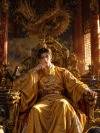
Beginning with a phrase that sounded suspiciously familiar to him, something very much like a chain letter, Hyang passionately explained the usefulness of Arabic numerals to Sejong.
Sejong listened to the entire presentation with a serious expression before stroking his beard thoughtfully.
After silently considering the matter for a while, Sejong finally reached a conclusion.
"It seems like an excellent idea. However, I do not believe this is something I should decide alone. Return tomorrow once court begins and explain it again before the ministers."
"Yes, Father."
Having finished his task, Hyang bowed respectfully to Sejong and withdrew.
As Hyang quietly backed away, Sejong suddenly called out to him.
"Hyang."
"Yes, Father."
"I am truly proud of your brilliance. However, you are still young. Rather than devoting yourself entirely to state affairs right now, focus more upon the growth of both your body and mind."
"Yes, Father."
At Sejong's praise, Hyang's face brightened and he bowed deeply.
Watching his excited son disappear into the distance, Sejong smiled faintly.
"Now he finally looks like a child his age."
Still smiling like a father watching over his beloved son, Sejong resumed examining the documents before him before suddenly clicking his tongue.
"Tsk. I forgot to ask him about that."
The next day, once court session began, Sejong summoned Hyang as promised.
Standing before the assembled ministers, Hyang explained Arabic numerals in detail.
"...Thus, I believe expressing numbers using these Indian numerals, which the Westerners call Arabic numerals, would prove far more useful."
After completing his explanation, Hyang bowed respectfully to Sejong and withdrew to one side.
Once the explanation ended, Sejong looked toward the ministers.
"What do you think of the Crown Prince's proposal?"
The very first to answer was Minister of Taxation Kim Jeom.
"In this minister's opinion, they appear extremely useful for expressing numbers."
"I, Minister of Personnel Heo Ji, share the same view. I also believe them highly useful."
The Ministry of Taxation, which used numbers more than any other department, immediately supported the idea.
Then the Ministry of Personnel, which likewise handled large amounts of numerical records, voiced support as well.
Once the ministers from the two departments most closely tied to calculations both agreed, Sejong reached a decision.
"Very well. Let the two ministries conduct a one-month trial using these Indian numerals. If the results prove satisfactory, they shall be implemented nationwide."
"We obey Your Majesty's command!"
After concluding the issue of numerals, Sejong moved on to the next matter.
"This next matter is something I believe the Crown Prince should hear and judge together with us. Crown Prince."
"Yes, Father."
"A decree has arrived from the Emperor of Ming."
The unexpected statement left Hyang staring blankly.
"...Pardon?"
Seeing the expression on his son's face, Sejong explained the full story.
Because Sejong had been so pleased with the gold pens created by Hyang, he ordered the Directorate of Military Supplies to produce an especially luxurious set as tribute for the Yongle Emperor.
The completed gold pen featured a gold nib decorated with silver inlay, while the holder itself displayed two magnificent dragons painted in imperial yellow lacquer.
The Yongle Emperor had been extremely satisfied upon receiving it.
Delighted by the gold pen, the emperor sent an imperial decree back through Joseon's birthday envoys who had traveled to celebrate his imperial birthday.
The decree read as follows.
-Offer ten thousand gold pen nibs as tribute.
-Knowing Joseon lacks abundant resources, I permit one thousand of the same quality as the original tribute item and nine thousand of slightly lower grade.
After receiving the decree, Sejong and the court immediately fell into deep concern.
The officially authorized gold pens currently sold under state supervision existed in four grades.
The special grade consisted of royal-use pens crafted from pure gold with silver inlay.
The first through third grades used gold, silver, and bronze nibs respectively.
Even though the Yongle Emperor claimed lower grades were acceptable, everyone understood he would likely only be satisfied with at least first-grade quality.
"If he wants ten thousand nibs, the budget alone will..."
Faced with the sudden demand from Ming, Minister of Taxation Kim Jeom muttered while clutching his pounding forehead.
"Why did the Crown Prince have to invent such a thing... No, why did His Majesty have to present it as tribute? There should be limits to boasting about one's child..."
"Minister!"
"Hup!"
At the vice minister's sharp warning, Kim Jeom instantly snapped his mouth shut and hurriedly checked his surroundings.
Fortunately, he remained inside his own office with only the vice minister nearby.
"Hooo..."
Releasing a sigh of relief, Kim Jeom lowered his voice.
"Pretend you heard nothing."
After hearing the situation, Hyang fell into thought.
Muttering quietly while running calculations through his head, he eventually looked toward Sejong.
"Father. What if we engage in trade?"
"Trade?"
"Trade? How could such a thing even be suggested!"
The moment Hyang uttered the word "trade," Chief Inspector Seong Eom of the Office of the Inspector-General nearly exploded in opposition.
But Sejong silenced him with a raised hand.
"Chief Inspector, remain quiet. Crown Prince, continue."
With Sejong's permission, Hyang resumed speaking.
"If Ming has sent an imperial decree demanding gold pens as tribute, then clearly they are receiving significant popularity there as well. Consider the vast territory of Ming and the number of people living there. No, consider merely the number of scholars. How many times greater is it than Joseon? If we contact the merchant guilds producing the gold pens, they should be capable of manufacturing additional quantities beyond the tribute shipment."
At Hyang's question, Sejong and the ministers all began calculating mentally.
And the conclusion arrived almost instantly.
'We could profit from this!'
Seeing their reactions, Hyang continued his explanation.
"Furthermore, we should attach merchants officially to the envoy missions. Not secretly tagging along in small numbers as they do now, but openly and formally."
The proposal was as follows.
Every merchant accompanying the diplomatic mission shall pay two seok of white rice per person. In exchange, the government shall guarantee food, lodging, and safety until their arrival in Beijing.
The court shall rent buildings near Hoedonggwan, the lodging facility reserved for Joseon envoys in Beijing, in order to support merchant trade activities.
Merchants shall surrender twenty percent of their profits to the state. High-value goods such as ginseng shall surrender forty percent.
If officials within the envoy mission or their attendants possess goods they wish to sell, they shall consign those goods through the merchants. Their profits shall likewise be taxed at identical rates.
Before departure, the Ministry of Taxation shall carefully record all goods and quantities intended for sale. Ministry officials shall accompany the mission to maintain accurate sales records throughout the expedition.
"...I believe implementing matters in this manner would be beneficial."
"Hm..."
Once Hyang finished explaining, Sejong and the ministers began carefully reviewing the proposal.
While evaluating the gains and losses of the plan, Chief Inspector Seong Eom finally spoke.
"This minister believes the Crown Prince's proposal absolutely must not be adopted."
"For what reason?"
"The Crown Prince's proposal would indeed generate enormous wealth. However, as recorded in ancient histories, excessive wealth inevitably corrupts both the royal house and the people through luxury and indulgence, eventually leading to oppressive taxation and tyranny."
"I, Chief Censor, agree with the Chief Inspector. True kingly governance lies in ruler and people alike embracing modest poverty, delighting in humble contentment, cultivating virtue, and spreading fragrant morality across the world so that neighboring nations admire us."
"I, Minister of Rites, also agree with the previous opinions. How could lowly merchants possibly accompany diplomatic missions sent to meet the Emperor of the Great Ming? Such behavior would disgrace the dignity of Joseon itself. Though the Crown Prince is undoubtedly intelligent, he still lacks sufficient understanding of governance and diplomacy. I humbly believe he should focus more deeply upon study so that he may properly understand governance and diplomacy rooted in the Way of the Sage Kings."
In simpler terms, they were saying:
"What does a child know about statecraft and diplomacy?"
At the combined words of the Chief Inspector, Chief Censor, and Minister of Rites, Hyang's eyebrows slowly rose upward.
"Hooo..."
Taking a slow breath to suppress his rising anger, Hyang turned toward Sejong.
"Father. May I respond?"
"I permit it."
Sejong's voice was noticeably unpleasant as well.
After receiving permission, Hyang began his rebuttal.
"To the Chief Inspector first. You claim wealth entering the nation will corrupt the royal family through luxury and eventually produce tyranny?"
"That is correct. If one examines the ancient records..."
"In those ancient records, rulers squeezed the blood from their people in order to sustain that luxury. Did I suggest squeezing the blood from our people? I suggested bringing wealth from outside."
"Perhaps it could enter from outside once. But who can guarantee such profits would continue forever? The first time people may buy the pens because they are novel, but afterward there are no guarantees. And once demand disappears, the burden will inevitably fall upon the people."
"Does the Chief Inspector live only for today?"
At the insolent question from a child barely eight years old, Seong Eom looked utterly dumbfounded.
"What kind of question is that?"
"Are gold pens the only goods merchants can sell? There are many other products! And how can you be so certain gold pens will only sell once?"
"Which minister among us even uses gold pens? People bought them only because they seemed novel at first. But they can never match the dignity and elegance of proper brushes! Gold pens are little more than toys for children!"
At Seong Eom's words, Minister of Taxation Kim Jeom, who had remained silent until then, suddenly stepped in.
"The Chief Inspector is mistaken. Do you know how many gold pens are consumed each month right now? Government offices alone consume sixty first-grade gold nibs monthly, while silver and bronze nibs combined exceed four hundred. And among the common people, over one thousand nibs sell every month. More than six hundred of those are first-grade gold nibs."
At Kim Jeom's supplementary explanation, Seong Eom's eyes widened enormously.
"Per month?"
"Per month."
Hearing the confirmation, Seong Eom muttered unconsciously.
"Heavens... How could such a frivolous object..."
The instant those words left his mouth, Hyang immediately cut in.
"My apologies. It must seem frivolous because a child created it."
"Hup!"
Realizing his disastrous slip of the tongue, Seong Eom instantly bowed deeply toward Sejong.
"Your Majesty! Please forgive this minister's careless words!"
"I shall forgive them."
"Your mercy is boundless!"
While Seong Eom secretly wiped cold sweat away, Hyang continued pressing his attack.
"The Chief Inspector and Chief Censor opposed this proposal using examples like ivory chopsticks and jade cups. However, for the sake of the people, this trade mission is absolutely necessary. Eunuch. Retrieve the book from my chambers titled Records of the Geography of the World."
"Yes, Your Highness."
A short while later, the eunuch returned breathing heavily and handed the book to Hyang.
Finding the desired passage, Hyang passed the book to the eunuch again.
"Present it to Father."
"Yes, Your Highness."
As Sejong examined the contents, Hyang resumed speaking.
"That book is one of the miscellaneous works I acquired through the envoys. As the title suggests, it records the geography and local products of China and neighboring nations. According to this text, the Jiangnan region of Ming harvests rice twice each year, while kingdoms even farther south, such as Dai Viet, harvest rice three times annually. Therefore, merchants accompanying the envoy missions must use their profits to purchase rice from Jiangnan and Dai Viet and bring it back here. Then that rice must be used to relieve the starving people of Joseon."
After speaking continuously for so long, Hyang paused briefly to wet his dry throat with saliva before continuing his assault.
"You speak of embracing poverty and humble contentment. Do you believe the people are poor because they desire poverty? They are impoverished because they are starving! Humble contentment? In summer they die from drought. In winter they freeze to death. In spring they starve to death! In such circumstances, who will praise the king's virtue no matter how much virtue he accumulates? While the people collapse and die from hunger, does national dignity truly matter that much? There is a saying in the markets. 'If a child starves for three days, even a scholar climbs walls.' What parent could remain still while their child collapses from hunger? The king is father to all the people! If the children cry from starvation, then surely we must do whatever can be done!"
"My son! Well said!"
Sejong's sudden shout instantly froze the entire court.
Hyang and the ministers alike stared at him with mouths hanging open.
Even the historians stopped writing and turned toward Sejong in shock.
Looking at his father, Hyang suddenly remembered his own first birthday celebration, when Sejong, still Grand Prince Chungnyeong at the time, had nearly come to blows with Yangnyeong during an argument.
Clicking his tongue inwardly, Hyang thought:
'Tsk. Amazing he managed to suppress that temper for this long.'