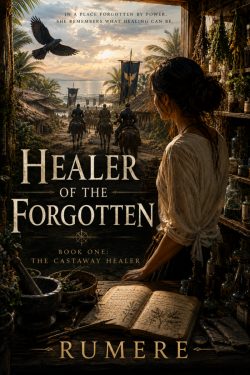
A 34-year-old trauma surgeon whose consciousness woke in the body of Marisol of House Silab, a noble daughter poisoned and left for dead by her own family. Goes by "Doktora" professionally in Sanlahi.
Heir-Commander of House Buhawi and Acting Lakan (military chair of the Council of Lakan). Maricel saved his life from a poisoned wound in Book One. Precise, guarded, and increasingly hard for either of them to keep at arm's length through their letters.
Bathala is a Tagalog word is often translated as "Supreme Lord" or "Great Creator." The supreme creator deity in pre-colonial Tagalog mythology.
An ancient omen-bird spirit, once bound to the Babaylan bloodline. Its seal cracked when Maricel's consciousness entered Marisol's body. The only being who knows Maricel is not the original Marisol. Usually appears as a large, dark, iridescent bird; has been seen once in human form.
The archipelago world of the story.
The independent practice Maricel built in Siyang's trade district, on a building leased through House Buhawi.
One of the Nine Territories of Sanlahi. Warrior culture, isolationist, known for iron and timber. Bathala's home territory.
A mountain territory of Sanlahi, known for rare plant compounds and an old, largely-absorbed healing tradition — the "Hagdan method" Anselmo trained in before the guild took it over.
The political and trade center of Sanlahi's Nine Territories, seat of House Silab and the Council of Lakan. Where Maricel now practices.
The small fishing village on Sanlahi's outer coast where Maricel first washed ashore and built her first practice.
Foreign ships and travelers occasionally glimpsed at Sanlahi's edges — unfamiliar clothing, unfamiliar flags, a presence still more felt than understood.
A formal seal of authority
A bonded-labor status in Sanlahi society. Contractual rather than hereditary chattel slavery; a bond can be bought out. Kiko is currently alipin, bonded to the Panlaot headman.
The warrior-noble class that serves the ruling datu houses.
The suppressed pre-guild tradition of healer-priestesses and spirit-workers, once organized into a network spanning the archipelago. Maricel's abilities are rooted in this bloodline.
An honorific meaning roughly "mother" or "elder woman," used respectfully (Ina Petra, Inang Cora).
Household or ancestral spirits, honored through small ongoing rites. Neglecting the rites can cause real, physical consequences for descendants.
Maricel's developing ability to perceive spiritual disturbance layered alongside physical illness — a shimmer at the edges of a patient that sharpens with unfocused attention and blurs under direct clinical scrutiny. Exertion carries a real physical cost.
Not a rank held by all nine rulers, and not one-per-territory. The Lakan is a single elected seat within the Council of Lakan — its military chair — held by whichever Datu, or Datu's recognized heir, the Council votes in to hold operational command during military matters, border disputes, and crisis response. There is only ever one Lakan at a time for the entire confederation. The seat can change hands based on performance and the Council's confidence; it is not hereditary. Bathala currently holds it as Acting Lakan — "acting" because he holds the seat as his father's heir exercising his father's authority, not as a Datu in his own right. His father, Datu Ramil Reyes, remains the actual ruler of Buhawi territory.
The ruling lord of a single territory. Every territory has one.
The loose confederation formed by all Nine Territories, active mainly in wartime and during large gatherings like the current Siyang session. Despite the name, the Council's regular members are the nine Datu — one per territory — not nine Lakan. The Council's seat rotates between territories every twelve years; Siyang currently hosts it. (See Lakan,for what the name actually refers to.)
The ruling house of Siyang; Marisol's birth family. Emblem: a golden flame over a trade-scale. Colors: oxblood red and hammered gold.
The ruling house of Buhawi territory; Bathala's family. Emblem: a coiling waterspout into a spear-point. Colors: storm-blue and steel-grey.
- Chapter Fourteen — What the Merchant Told4 hours ago
- Chapter Thirteen — Ina PetraJul 12, 2026
- Chapter Twelve — The First Fever SeasonJul 10, 2026
- Chapter Eleven — The Village WatchesJul 8, 2026
- Chapter Ten — First Real EmergencyJul 7, 2026
- Chapter Nine — Building with NothingJul 6, 2026
- Chapter Eight — The Headman’s RequestJul 3, 2026
- Chapter Seven — What Marisol’s Mother WasJul 2, 2026
- Chapter Six — TigmamanukanJul 1, 2026
- Chapter Five — The Pressure Behind Her EyesJun 30, 2026
- Chapter Four — What the Village KnowsJun 29, 2026
- Chapter Three — The Fisherman’s LungJun 29, 2026
- Chapter Two — InventoryJun 29, 2026
- Chapter 1 – The Wrong ShoreJun 29, 2026