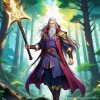
It’s a fascinating thing, the human brain.
Jack thought softly about memories he could no longer grasp onto. He reached out with an invisible arm, tossing open grand doors made of teak, oak, pine, magic wood, clay, iron, steel, cloth, snow, and even flesh as he searched for something hidden. Even worse than when there is a word that won’t appear, an elusive name of a famous actress, or a relative’s birthday that might be the sixteenth—or was it the twenty-sixth?—Jack knew there was something he needed to remember but just could not figure out what.
The next door swung open. It was one Jack hadn’t approached in a while. One that he’d definitely forgotten had existed. A small, mouse-like door that was almost hidden from view. He’d never have seen it if he hadn’t suddenly decided to crane his imaginary castle-going head downwards towards the blue-and-yellow patterned floor. There was a small knocker on the front of the door that reminded him of a nose ring, a trend he’d never so much as gotten behind, and an even smaller silver doorknob which he forwent and instead entered by envisioning himself moving into the space.
The castle dropped around him with a whoosh, a sensation he’d long gotten comfortable with and another, much smaller set of four unpainted walls, a small low-hanging roof, a bare floor, and a single couch sat in the center of the room. With a still extended arm, Jack approached the worn-out, clearly reupholstered, velvet teal couch. The couch was warm. Someone must have been sitting on it recently. The walls shook, the couch shrunk to nothing, the ground dropped, and the memory vanished.
Jack searched again for the room, wandering down hallway after hallway, eyes glued to the floor for other mouse-sized doors he’d not known existed. After what could have been milliseconds or days, Jack’s mind grew tired as weary minds do and he retreated from the palace, returning full focus to his body which had continued on regardless of his attention. He found himself where he’d left himself, smack on the border between forest and the tree graveyard which he’d left in his wake.
Maniacally, he chimed a song to the tune of row-your-boat, the original words he’d long forgotten. His voice was hoarse as expected of one who had sung enough songs for thousands of lifetimes, but he still perfectly held the tune, heaving his axe above his head and thwacking it into his next victim’s trunk with uninterrupted precision.
“Swing, swing, swing the axe. Chop into the tree. Jackily, Jackily, Jackily, Jackily. I can fell this tree.” He’d thought hard about another rhyme for tree, but after singing the song several times in an attempt to spur inspiration, it’d grown too much on him and he refused to let it go. Unfortunately, this tenacity leaked into other aspects of Jack’s life, like the less glorious and slightly disturbing song he’d found himself singing during common bouts of constipation which he’d titled: Squeeze, squeeze, squeeze your poo.
“Swing, swing, swing—” he continued the next verse, as his two wrinkled hands swung his worn-out axe. The blade whooshed through the air and splintered into the tree’s thick trunk, spewing out chunks of bark that twinkled. Unlike regular trees, a magic tree’s rings did not indicate its age. The luminescent reds and browns and blues and golds grew with the tree and the world around, each as unique as a fingerprint and could grow and shrink, shift and recede to which some trees had only a single core ring passing through the center of their trunk with thousands of smaller paths that branched out like veins while others seemed to grow with no rhyme nor reason, creating concentric rings of seemingly random colors. Jack wasn’t sure if he’d once known why the trees were as they were and forgotten or if he’d never known at all. Either way, he wasn’t really bothered.
Even with splinters flying towards his face, Jack did not bat an eye. Although returned from his memory palace, his taut gaze still seemed to look through the bleeding tree, through the air, the woods, and through time itself. He was waiting for something very specific to appear.
The man paused his song with his twentieth swing of the axe and waited for the telltale creak, rumble, and eventual thunk as the trunk collapsed and toppled to the ground, joining its fallen brethren.
“Seven-hundred-and-thirty-two,” he counted aloud before taking a deep breath and continuing towards the nearest still-standing tree. As he stepped, he switched to a new tune, this one slow and solemn, mimicking the strange longing for something he felt but couldn’t place. One hand freed glistening flakes of wood from his unkempt beard, once a jet-black, then grey, and now a powerful white. Eyelids grew heavy with the song, and drooped until they were nearly closed.
Only able to see a blurry sliver of a tree before him, but needing even less, Jack raised his arms to the sky. Muscles bulged from forearm, to shoulders, to back, uncustomary for a man of his age, but not even he remembered that anymore. He was the only human he’d seen in ages. He was the only human he could remember. He wasn’t even sure anymore if there were others. He’d been alone for too long.
“Oh I am a poor sailor, alone in the sea—” he continued perfectly to the SpongeBob theme music, having no recollection of SpongeBob, TV, or even what the sea was. The word like many others he never used had since lost meaning, and wound up as just another sound. The thunk of tree after tree crashing to the ground did not cause even a flinch in Jack’s sturdy progression and he continued on with his labors.
“Seven-hundred-and-sixty—” Forgetting his place, Jack paused his count and glanced behind him, as if that would spark his failing memory. With a hum, a haw, and a scoff, he added, “Who the hell cares anyways?” He looked to the sky and to the sky-gods he planted there, opened his eyes wide, and chuckled, “I’m going with seven-hundred-and-sixty-three. That’s a good number.”
Slowly he lowered his head and stepped towards the next tree, moving without much thought, raising his axe, and swinging with vigor. Again, he chopped, ignoring the sweat that trickled down his thick brows, burned through his bloodshot eyes, and soaked into his bird’s nest of a beard.
“Timber!” he shouted.
The tree cracked, grumbled, and leaned to one side.
“Seven-hundred-and-sixty-four,” the man mumbled.
“Nine-hundred-and-two,” he said again sometime later.
With the sun now at its peak, the rays bore down even harder on Jack’s leathery, wrinkled, browning, uncloaked skin. An average man would’ve collapsed hours earlier beneath the sun, the heat, and the work. An exceptional man might’ve lasted slightly longer. A one-in-a-million genius might’ve kept up and felled a hundred or so of the mighty oaks, or redwoods nearby, but not the magic trees. Not even they would likely be able to fell one of them without practice, technique, and most importantly, skill. But Jack, while he once might’ve been an average man, he was average no longer. It’d been decades since the sun had caused him any bother. Decades since sweat falling into his eyes actually caused a sting. Decades since the puss and blood-leaking blisters loosened his grip.
With a blurred blink, the bark of the next tree sparkled, and Jack found himself mouthing more words he did not remember. Orion. The Big Dipper. The Huntress. Each word stirred his pained heart and he stared closely at the alternating patches of light and dark, trying to remember.
“Stars,” he said aloud, voicing all of the words that flowed with the newfound memory. “Constellations. Stars. Gas giant. Space. The moon. Mars. Apollo. Buzz Lightyear.” With nothing but time, he halted his labors and allowed his eyes to drift shut and his mind to run over the words time and again. Images of books with diagrams, blurred words on pages, a bed of grass, a blanket, a warm touch in his hand, and twinkling stars in the sky above. Tears slowly trickled down from his eyes. The memory felt warm, happy.
Sometime later, Jack opened his eyes, looked at the twinkling bark, tightened his grip, and swung. “The Star Slayer,” he chuckled with his second swing when suddenly, a tightness grasped around his heart, and he flinched and fumbled his trusted tool. The blade curved downwards into the trunk—a mis-swing—piercing only a hand’s length before locking up entirely and wedging itself deep into the wood.
“Not yet,” he gasped, ”I’m not ready.”
He tensed and yanked the handle, but the hatchet didn’t budge. Again, he pulled, huffing for air as his heart began to ache.
“Give me one more,” he grumbled angrily, “I can feel it. I’m so close.”
The ache turned to sharpness and then to a stabbing pain but still, the man did not yield. Strained, he raised one foot against the trunk, gripped one hand beneath the axe’s head, the other at its butt, and yanked with all his might. His heart thumped into his ears as blood rushed through bulging veins.
The wood creaked.
The man let out a low, bestial roar.
To the man, the moment lasted an eternity. However, he was no stranger to eternities and poured every ounce of his soul into this final struggle.
A loud crack echoed as the blade ripped free. Jack staggered backward, pelted with spray from the tree, before he toppled backwards and slammed his head heavily against a nearby stump. Vision flashed black. Air rushed from his lungs.
“That’s fair,” Jack coughed blood with each word, “I’ve killed so many of your kind after all.”



Tfw you will never live to be a deranged lumberjack wizard
I the start!